Following a Developing Story Without Filling the Gaps
Following a developing story without filling the gaps helps you separate new facts from repeated claims, track what remains uncertain, and read updates with care.
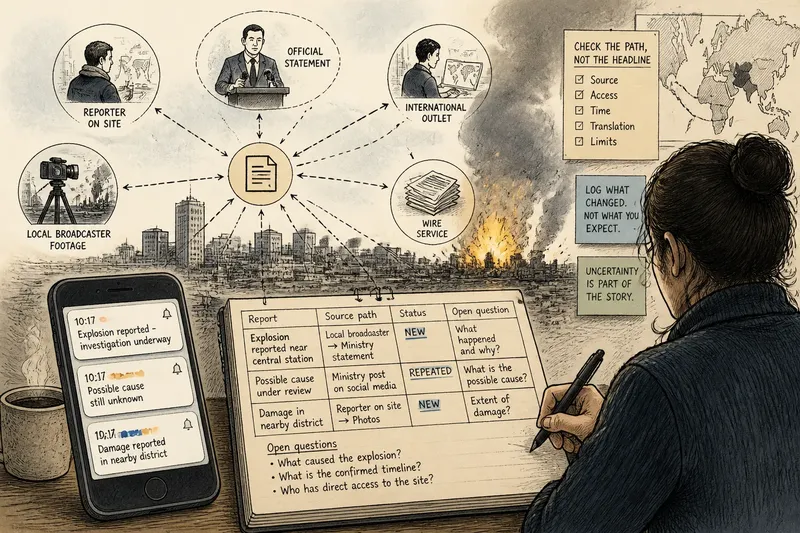
Your phone lights up with three alerts about the same explosion. One mentions an investigation, another a possible cause, and a third damage nearby. Following a developing story without filling the gaps means resisting the urge to turn those fragments into one complete account before the evidence connects them.
Instead of building a single narrative, keep a small log of what changed, where reports came from, and which questions remain open. This is especially useful in international coverage, where translation, distance, and different access to events can shape what reaches an audience. Your log is not a verdict; it is a map of the reporting so far.
What belongs in a developing-story log?
Start with a neutral description and the time you began following the story. “Explosion reported near the central station” leaves room for new information. “Attack at the station” assumes a cause that may not be established.
Use a notes app, a paper page, or a simple table. Keep four fields:
- Report: The specific detail or claim, written in plain language.
- Source path: The outlet and the person, organization, document, or other report it relies on.
- Status: New, repeated, clarified, disputed, corrected, or still unresolved.
- Open question: What this report does not answer.
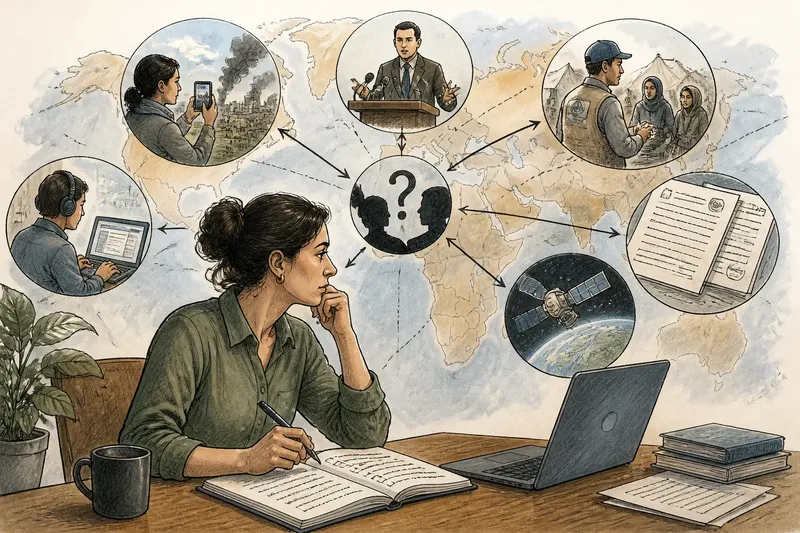
These fields shift attention from whether a headline sounds convincing to how information is traveling. For an international story, note whether an outlet is reporting directly from the scene, translating a statement, citing a local news organization, or relaying a wire-service account. Each route can offer useful information, but they are not interchangeable.
How can you trace where a claim came from?
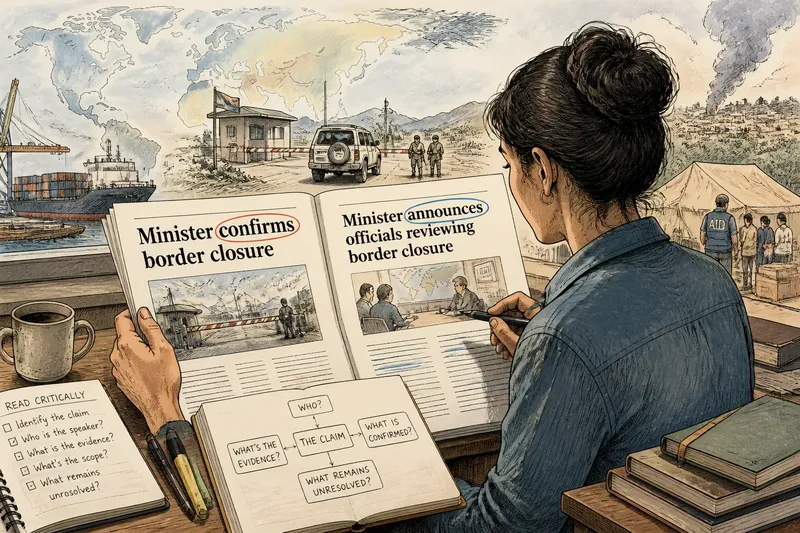
Look beyond the outlet name. Read the article for phrases such as “according to the ministry,” “a local broadcaster reported,” or “the reporter saw.” Then record the earliest source the article identifies, not just the latest outlet to repeat the claim.
Several stories can appear to corroborate one another while drawing on the same announcement. A useful way to picture this is a family tree: multiple branches do not mean multiple roots. If reports point back to one source, note that shared origin rather than counting each headline as a separate account.
Also record the kind of access behind a report. A reporter’s direct observation may establish what was visible at a location, but not what caused it. A translated statement may convey an official position, while leaving open how terms were rendered or what context was omitted. Keep those limits attached to the relevant entry.
How should you record conflicting accounts?
Write down each version with its source and time, then state the disagreement precisely. Do the accounts differ about the location, timing, sequence, or explanation? Avoid smoothing the conflict into a middle version that no source actually reported.
Say you are following a hypothetical port closure in a country where officials and a local residents’ group describe the disruption differently. At the start, your log has an official notice saying access was restricted after a security alert, and a residents’ group post saying the gates had already been closed before the alert was announced. First, record each statement with its publisher and timestamp. Next, check whether either account links to a document, image, or direct observation, and note any translation involved. Then write the unresolved point as: “The reported sequence differs; the material reviewed does not establish when the gates closed.” The result is a clear record of the disagreement, not a guessed timeline.
Not every difference is a contradiction. One report may describe a port entrance while another describes the wider facility. Check whether the sources are answering the same question before marking their accounts as opposed.
What should you do when coverage changes?
Compare each update with your existing log. Mark whether it adds a detail, clarifies wording, disputes an earlier account, or corrects it. Keep a short note of the previous version when the change affects the story’s meaning.
A late-arriving detail is not automatically a correction. It may describe something that happened earlier but was only reported later. A correction, by contrast, signals that an earlier report was inaccurate or materially incomplete. Read the update’s explanation and record which of those situations the outlet describes; if it does not say, leave that point open.
Watch for a mismatch between a confident headline and cautious article text, or for a revised story that gives no explanation. Record the article’s current wording and the unexplained change. You do not need to save every alert; preserve the changes that alter the account or the source path.
Which questions help you read international updates?
How do I tell whether reports are independent?
Follow each report’s stated source path and note shared announcements, wire copy, or cited outlets. If several stories trace back to one account, treat them as circulation of that account rather than separate confirmation.
What should I do with a translated statement?
Record who published or translated it and keep the original wording available if the report provides it. If a key term has more than one plausible rendering, note that uncertainty instead of choosing the version that best fits a preferred explanation.
How should I interpret a lack of official comment?
Write that the reports you reviewed contain no comment from the relevant office. Silence alone does not establish what happened, why it happened, or what the office knows.
When is it useful to check again?
Return when a specific open question matters or a source says more information is expected. If alerts only repeat the same account, pause rather than treating repetition as progress.
How do you keep the log useful without overloading it?
Use short entries and keep one question open at a time. For example, a compact record might say: “Port access restricted: official notice cites a security alert; residents’ group disputes the timing; the sequence remains unresolved.” That sentence preserves the disagreement and its subject without implying that either account has settled the matter.
Before sharing an update, check what your wording does to the source path and the uncertainty. “Officials say access was restricted after an alert; a residents’ group disputes the timing” tells readers who said what. “The alert caused the closure” makes a stronger claim than those notes support.
Following a developing story without filling the gaps is not about keeping every question unanswered. It is about letting each claim carry its origin and limits until the reporting can resolve them. When you return to the story, that record helps you recognize what genuinely changed—and what simply traveled farther.