Who Can Know This? A Reader’s Test for News Sources
Use this news source test to separate direct observation from second-hand claims and see what evidence supports an account before you share it.
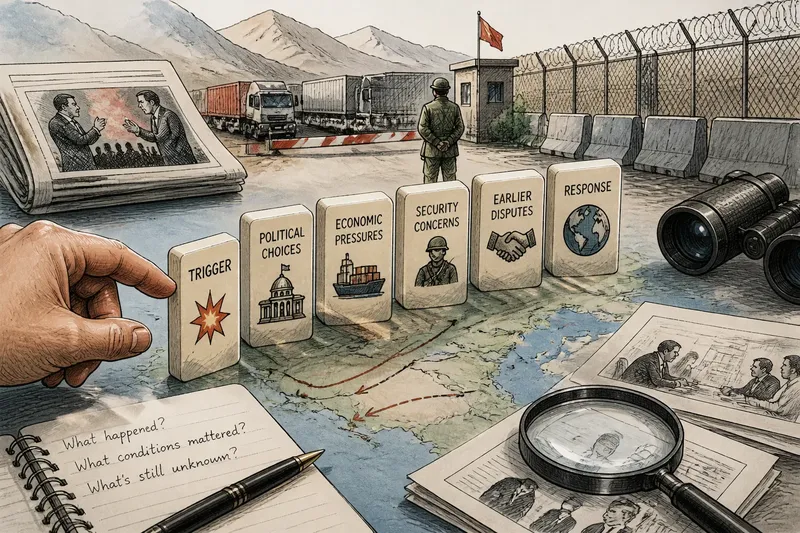
A reporter’s post says a port is closed, but the attached clip shows only a line of trucks outside a gate. The scene may be real; the claim may still reach beyond what the image can establish. A useful news source test begins with one question: who could know this, and how?
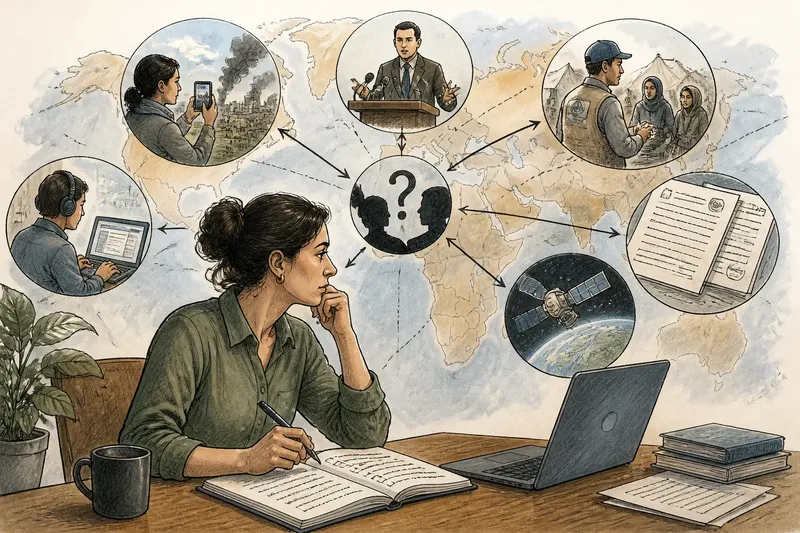
That question is especially useful in international news, where a single story may pass through local witnesses, officials, translators, aid groups, wire services and social media accounts. Each person can contribute something valuable. Each handoff can also blur what was seen, heard or inferred. The aim is not to dismiss a source because it is distant or anonymous. It is to match the strength of a claim to the source’s access and the evidence available.
What kind of source are you looking at?
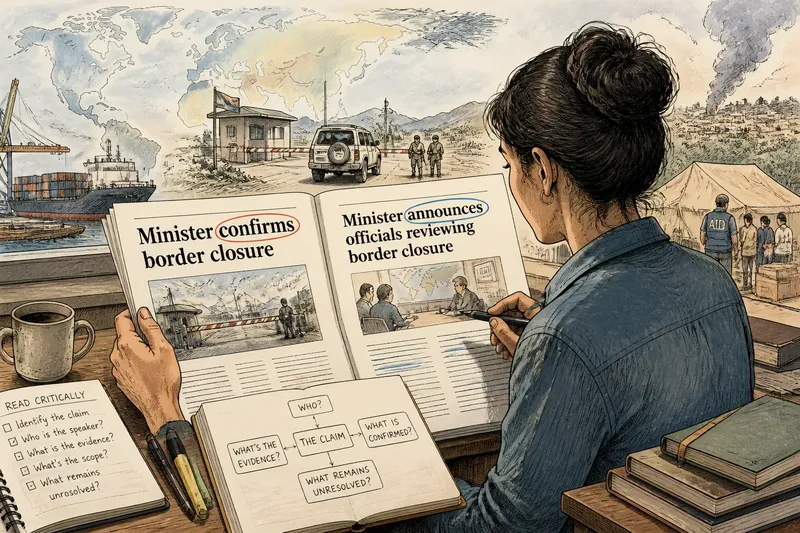
Start by separating the source from the claim. A source might be a person at the scene, a government ministry, a news organization, a video, or a document. A claim is the particular thing that source says happened. One source can support one claim well and another poorly.
For each important claim, ask what relationship the source has to the event. Did they see it? Did they hear it from someone involved? Are they interpreting records or repeating an account from another outlet? These are different kinds of access, not a simple ranking from trustworthy to untrustworthy.
- Direct observer: Someone says they saw or heard the event themselves. Their account may be strong for what was visible or audible from their position, but not necessarily for what caused it or what happened elsewhere.
- Participant or official: Someone involved, or responsible for an institution’s response, may know operational details. They may also have limited information, a particular role, or an interest in how the event is described.
- Second-hand source: Someone recounts what another person told them. That account can be useful, but readers need to know how many handoffs occurred and whether the original observer can be identified.
- Document or recording: A record can show what it contains, such as a written order or a visible scene. Its origin, completeness, timing and interpretation still need attention.
- Analyst or journalist: An account may combine several sources and explain their significance. Look for a clear distinction between observed facts, attributed claims and the author’s interpretation.
These categories can overlap. A local reporter may witness damage, interview residents and quote an official. Read the attribution around each sentence rather than assigning one label to an entire article.
How much can this person directly observe?
Direct observation has a boundary. A person standing near an explosion may describe a flash, a sound, or damage they saw afterward. They may not know what caused it, where it originated, or who ordered an attack. Those further claims need additional evidence.
Ask about vantage point and timing. Was the source present when the event occurred, or did they arrive later? Could they see the whole scene, or only a doorway, road or screen? Did noise, darkness, distance or a language barrier limit what they could perceive? A specific account often makes these limits easier to recognize.
Say you see a resident’s video showing smoke above a neighborhood. The resident says they filmed it from a nearby balcony just after hearing a loud blast. That supports the narrower account that smoke was visible from that location after a loud sound; it does not, on its own, identify the cause, target or responsible party. The distinction is like looking through a keyhole: a clear view of one corner is still not a view of the whole room.
Do not treat confidence as a substitute for access. A speaker can sound certain while describing an inference, and a cautious witness can have firsthand knowledge. Look for wording such as “I saw,” “I was told,” “the document says,” or “we believe,” then check whether the article preserves those distinctions.
What changes when the account is second-hand?
Second-hand reporting is common and sometimes necessary. People may be unable to speak publicly, journalists may not reach a location, or an official may relay information gathered by another team. The relevant question is not simply whether the source is firsthand. It is whether the reporting makes the path of information visible.
Trace the account backward. Does the speaker identify who told them? Was that person present? Is the original account based on direct observation, a document, or another unnamed source? If the chain stops at “people say,” readers cannot assess the first link. That does not automatically make the claim false; it means the basis is less clear.
Watch for repeated accounts that may not be independent. Several outlets can report the same claim while all relying on one news agency, one official statement or one anonymous witness. Multiple repetitions can make a claim feel settled without adding a new source. Look for explicit descriptions of independent confirmation, not just a growing number of headlines.
Translation adds another link. A quotation may have passed through an interpreter or been translated from a local language. That can be unavoidable, but readers should distinguish a translated quotation from a direct transcript and notice when a key phrase carries uncertainty. A small difference in wording can matter, especially when a speaker’s intent is being described.
Which evidence supports the account?
Evidence is not limited to documents or images. It can include a witness account, a recording, a public statement, a court filing, satellite imagery or physical records. The question is what each item can establish and whether it is connected to the claim being made.
A photograph may show visible damage but not when it happened. A video may establish that a scene was recorded, but its location or date might remain unknown. A document may contain an official assertion without independently proving that assertion. A named expert can explain how an image or record should be interpreted, but expertise does not make every underlying detail certain.
Look for how a news account handles the evidence. Does it explain where an image came from and how its location was assessed? Does it link to a document or quote the relevant passage? Does it tell readers when a claim could not be independently verified? These details let you judge the support instead of relying on the authority of the outlet alone.
Evidence also has scope. If a record confirms that a meeting took place, it does not necessarily confirm what everyone said in the room. If an organization reports receiving accounts from several people, that can support the fact that those accounts were collected; it may not settle every disputed detail. Keep the conclusion close to what the evidence actually shows.
Which source test fits your situation?
What if you are reading a breaking alert?
Check whether the alert attributes the claim and marks what remains unconfirmed. In the first hours of a fast-moving story, a named official or witness may offer useful information without settling the full account; treat precise causal claims cautiously if their basis is not described.
What if you are assessing a dramatic clip?
Separate what is visible or audible from claims about its place, date and cause. Seek context about who posted it and how its location or timing was checked, and do not infer more than the recording can show.
What if you are reading an official statement?
Note the institution’s access to the event and its role in it. A statement may reliably establish what the institution is claiming or doing, while claims about disputed events may need support from records, witnesses or other independent reporting.
What if several outlets repeat the same claim?
Check whether they cite separate sources or trace back to one original account. If the reports share a source, they may broaden distribution without adding independent confirmation.
How should you describe what remains unknown?
Use language that keeps the claim’s source attached to it. “The ministry said,” “a resident who filmed the scene described,” and “the video appears to show” convey different levels and kinds of support. Removing those phrases can make an attributed claim sound like an established fact.
When a report does not explain how a source knows something, that gap is worth noticing. You can pause before sharing, look for a fuller account, or state the uncertainty plainly. A source-checking habit is not a verdict on a person’s character; it is a way to avoid asking one account to carry more than it can bear.
For the next international story you read, keep the news source test focused on three points: what the source directly observed, what reached them second-hand, and what evidence supports the specific claim. That small separation helps you read a witness as a witness, an official statement as a statement, and an unresolved detail as unresolved.