The One-Event, One-Cause Trap
The one-event, one-cause trap turns complex international news into a tidy story. Learn to separate immediate triggers from the conditions that made them matter.
A government announces a sudden border closure, and within minutes the headlines point to a single cause: a dispute over a neighboring country’s election. The link may be real. But readers still need to ask what made this moment consequential, which earlier conditions shaped the response, and what remains unknown. The one-event, one-cause trap turns a connection into a complete explanation before the reporting can support one.
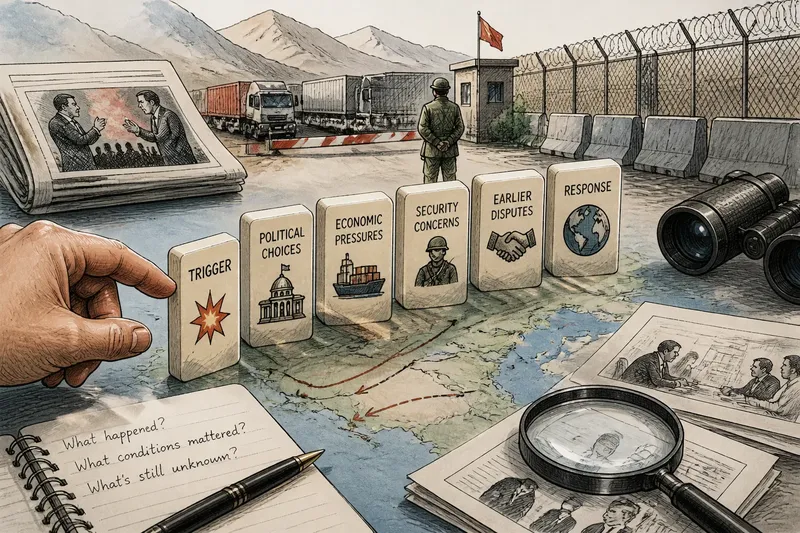
International events often unfold through several layers at once. A particular decision can set events in motion, while economic pressures, political choices, security concerns, and earlier disputes influence how people respond. Separating these layers helps you follow the story without pretending that every factor has equal weight—or that the causes are already settled.
What does the one-event, one-cause trap miss?
The trap appears when a report treats one visible event as both the starting point and the full explanation. A protest begins after a disputed court ruling; the ruling becomes the story’s only cause. A government imposes a trade restriction after a diplomatic clash; the clash is presented as the reason for everything that follows.
Those events may explain timing. They do not automatically explain why a protest drew support, why a government chose a particular response, or why a diplomatic clash escalated. A short explanation can be accurate about what happened just before an event and incomplete about the forces that made it matter.
There is a useful distinction here: an explanation is not the same thing as a sequence. “The ruling came before the demonstrations” describes order. “The ruling caused the demonstrations” makes a stronger claim. To support the stronger claim, reporting needs to show a plausible connection and consider other conditions and possible causes.
Think of a row of dominoes on a table. The first tile may tip the next one, but the spacing, arrangement, and force of the push shape what happens afterward. In international news, the trigger is one tile; the arrangement may include years of policy, competing interests, and previous events.
How is a trigger different from a condition?
A trigger is an event close in time to a response that helps explain why it happened then. A court decision, an attack, a failed negotiation, or a sudden change in policy can serve as a trigger. The word describes a role in the sequence, not proof that the event was the sole or decisive cause.
A condition is an existing circumstance that shapes how an event unfolds. It might be a longstanding dispute over representation, reliance on a particular trade route, weak trust in public institutions, or an established security arrangement. Conditions can make some responses more likely, more costly, or more politically useful without causing a specific event on their own.
The distinction is about timing and function, not importance. A trigger can be dramatic yet insufficient as an explanation. A condition can be longstanding and influential while leaving open why a particular decision happened on a particular day.
It also helps to separate causes from consequences. If officials announce a policy and neighboring governments respond, those responses may become part of the next stage of the story. They cannot explain the original announcement unless reporting shows that decision-makers anticipated them or were reacting to earlier versions of the same pressure.
How can you trace the connections without overclaiming?
Start with a simple timeline. Write down the reported event, the immediate response, and any earlier development the story identifies. Keep the wording neutral: “The cabinet announced the restriction”; “the neighboring government recalled its ambassador”; “talks had stalled before the announcement.” Avoid inserting “because” until the reporting gives you a reason to do so.
Next, ask what kind of link the story is claiming. Is one event described as preceding another, prompting it, enabling it, or making it more likely? These are different claims. A sequence needs dates or ordering; a claim about motive needs evidence about decision-makers; a claim about broader conditions needs context that connects those conditions to the choices at hand.
Look for the bridge between the proposed cause and the outcome. A report might describe a public statement, a policy document, a formal decision, or an account from someone involved. A commentator’s interpretation can help frame possibilities, but it should not be confused with direct evidence of what officials intended or what a population broadly believes.
Then look sideways. Were there other developments happening at the same time? Did officials offer a different explanation? Could the same condition have led to a different response? These questions do not require you to invent alternatives and treat them as equally likely. They help you see whether the story has established a connection or simply selected one plausible account.
Say you read that a port shutdown followed a dispute over fishing rights. Imagine the report also says that a new customs rule had been under discussion, but gives no evidence that it influenced the shutdown. You can record the fishing dispute as the reported trigger, the customs debate as a possible background condition, and the relationship between them as unestablished. That wording preserves what the story tells you without converting proximity into proof.
What should you ask before accepting a single-cause account?
What happened immediately before the event?
Identify the development that the report places closest to the event, then check whether it establishes timing alone or a direct connection. A clear timeline can explain why a story broke when it did without showing that the preceding event was the only cause.
What conditions were already in place?
Look for earlier policies, disputes, relationships, or constraints that the report links to the decisions being covered. Background details matter when the story explains how they influenced choices, not merely because they existed.
Who says the event caused the response?
Notice whether the claim comes from an official statement, a document, an analyst, a witness, or the reporter’s narration. Each can contribute useful information, but they support different kinds of claims about motive, sequence, and wider political conditions.
What part of the causal chain is still missing?
Ask whether the report shows how the proposed trigger led to the response, or leaves that connection assumed. If an important link is absent, treat the explanation as a possibility or an attributed claim rather than a settled account.
Why can the trigger still matter even if it is not the whole cause?
Resisting a single-cause explanation does not mean every factor deserves equal attention. Some events plainly change the options available to governments or communities. A sudden attack, a new sanction, or an unexpected resignation may sharply alter the situation even when longer-running tensions help explain the stakes.
It is also possible for different causes to operate at different levels. A decision-maker may cite a specific security incident as the reason for a policy. Earlier political incentives may help explain why that policy was chosen over other responses. A regional power balance may help explain why other governments react as they do. Those layers can coexist without one automatically discrediting the others.
Be careful with claims about what “a country” or “the public” wants. A country contains institutions, officials, groups, and people with different interests. A government statement may explain its stated reason, but it does not on its own establish a single motive shared across a population. Reporting that distinguishes the actors helps keep causal claims at the right scale.
Finally, allow the account to change as evidence develops. Early coverage may have a strong timeline but limited access to internal decisions or longer-running negotiations. Later reporting may clarify a link, revise it, or reveal competing explanations. Updating your account is not a failure of judgment; it is part of keeping the explanation proportionate to the evidence.
When you next encounter a confident single-cause explanation, keep the one-event, one-cause trap in mind and mark three things separately: the trigger, the conditions, and the links the reporting actually supports. That small distinction leaves room for a cause to matter without asking it to explain an entire international story by itself.